
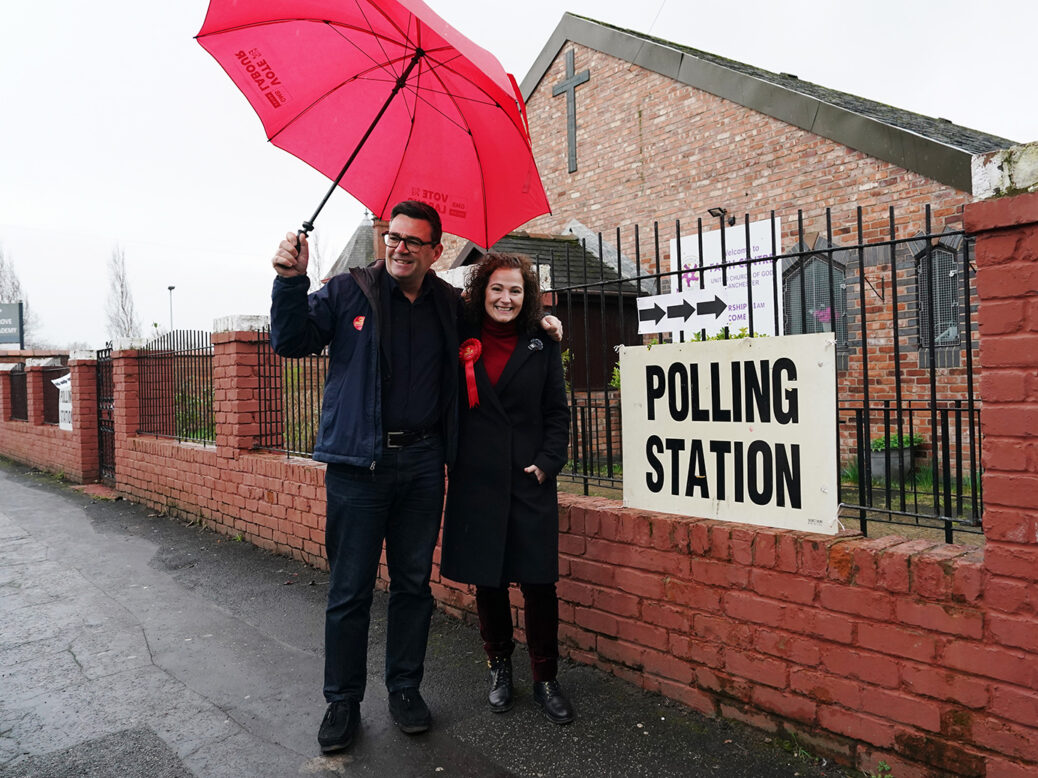
If Andy Burnham succeeds in the Makerfield by-election next month, Labour will immediately face a new challenge: a Greater Manchester mayoral by-election. There’s no guarantee the party would win without Burnham as the candidate. And regardless, the new mayor would face another election campaign in 2028, when Burnham’s term is due to end. But which party is most likely to win the mayoralty if Burnham steps down?
Greater Manchester effectively backed Reform in May’s local elections. The aggregated results across the mayoral region show Reform led with 31 per cent of the vote and just under 260,000 ballots cast. Labour was pushed into second place with 23 per cent of the vote – around 196,000 votes. The Greens came third on 19 per cent, winning roughly 160,000 votes, only 30,000 behind Labour. The Conservatives and Liberal Democrats each recorded around 10 per cent, with a further 7 per cent split between independents and minor parties. The result is a fragmented political map across towns and cities, sharply different from Burnham’s 63 per cent victory in 2024.
A mayoral by-election would currently be held under first past the post, not the supplementary vote system previously used for mayoral elections, as legislation to change the system has not yet been enacted. That distinction matters: under a preferential system, a progressive consolidation of votes might offer Labour a narrow route to victory. Under first past the post, Reform would appear to start as clear favourites.
But two factors could reshape that picture: turnout and the political backdrop.

Let’s start with turnout. Labour’s support is traditionally weaker in local elections than in general elections, and Greater Manchester follows that pattern. However, turnout in the recent local elections was higher than both 2022 and 2024. Notably, increases were strongest in areas where Reform performed best and where Labour’s losses were deepest – suggesting the right is no longer confined to low-turnout contests, but is also competitive in higher-engagement settings.
That said, this pattern is not identical to the early 2010s Ukip surge, when gains were more tightly correlated with disengaged electorates. The Green vote, by contrast, showed no clear relationship with rising turnout.
Reform’s vote appears unusually well-mobilised, though there are signs of softening at the margins as tactical voting increases – even if it remains limited. Still, Labour’s apparent weakness in Greater Manchester may be somewhat overstated, though the key question is what kind of election this would become.
A mayoral by-election would need to resemble a national contest in intensity to maximise Labour turnout. Without that, the current numbers would favour Reform. It is in that context that figures such as Gary Neville have been floated as potentially standing for Labour, as the party searches for candidates who could grab attention and raise turnout.
The second factor is context.
A by-election would only occur if Burnham first won the Makerfield contest – itself far from certain. Modelling based on Survation’s Gorton and Denton “exit poll”, applied through Britain Predicts, suggests a Burnham candidacy would put Labour just ahead of Reform by around three percentage points – roughly a margin of a few hundred to a thousand votes. Tight enough to make either outcome plausible.
A defeat for Burnham would land as a major setback for Labour, though it could also strengthen Keir Starmer and Wes Streeting within the party. A win, however, would immediately change the political narrative.
Burnham’s recent interventions – including his Mirror interview and subsequent remarks since entering the Makerfield race – have been widely read as signalling a broader leadership pitch, framed around a “new path for Britain” and “circuit-break” policy change. While he stops short of explicitly challenging Starmer, the direction of travel is clear enough to shape expectations.
Any subsequent Greater Manchester by-election would therefore not take place in a neutral political environment, but in the shadow of a potentially destabilised Labour leadership. What this means for Manchester is not yet clear.
[Further reading: The Labour Party is dead, and Starmer has killed it]
Content from our partners


Related
Join the debate
Subscribe here to commentIs there no other viable candidate than Gary Neville?
” Greater Manchester by-election would take place in the “
Light of Starmer gone and Streeting vanquished.